You have a product idea, an early prototype, or software that needs to grow. Now you need a development team.
Searching for the “best software development companies in Los Angeles” gives you plenty of names. What it does not tell you is which team understands your product, what their proposal includes, or who will support the software after launch.
This guide gives you a practical way to make that choice. It also includes a few companies you can use to begin your research.
#What does “best” mean for Founders?
The right company depends on what you need to build.
A founder testing a new idea may need help choosing the smallest useful first release. A business replacing an internal system may need a team that can understand existing workflows and connect with several tools. Someone with a working prototype may need an engineering review before inviting real users.
#Before you contact agencies, write down:
- Who will use the product: Customers, employees, partners, or more than one group?
- What they need to do: Describe the main task in plain language.
- What already exists: An idea, design, prototype, or working software?
- What matters most now: Testing demand, launching, replacing a process, or improving reliability?
If you are still defining the first version, our guide to turning an AI MVP idea into a working product explains how to focus on the problem and the features needed to test it.
Software development companies to consider in Los Angeles, Use this as a research shortlist, not a ranking. These companies appear in the current Los Angeles area for software development listings. Their published profiles can help you decide whom to contact, but you should check out recent projects and speak with the proposed team before choosing one.
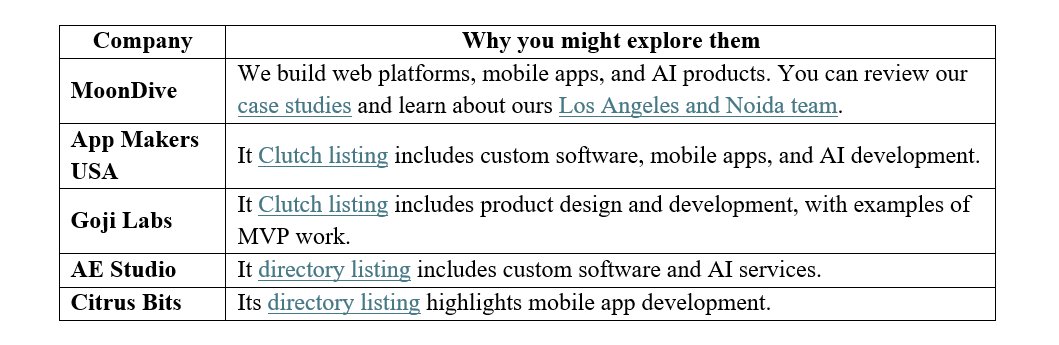
MoonDive publishes this article and appears in the shortlist. We have not independently tested or scored the other companies, and no company listed here is the best fit for every project.
#How to compare software development companies
#1. Look beyond the portfolio image
A polished screen shows you what a product looks like. It does not tell you what problem the team solved or what happened after launch.
Ask each company for a project like yours. Then ask:
- What was the client trying to achieve?
- Which parts did your team design and build?
- What was difficult about the project?
- How did the product change after testing or launch?
A detailed case study makes these questions easier to answer. For example, our HYBRED case study describes the problem creators faced, the product structure, and the mobile app built around it.
#2. Find out who will do the work
Ask to meet the person who will lead your project. Find out who will make product decisions, design the experience, write the software, and handle issues after launch.
This matters whether the team works entirely in Los Angeles or across locations. MoonDive, for example, has offices in Los Angeles and Noida. If you consider a team with that structure, ask how meetings, decisions, and working hours will be handled for your project.
#3. Ask how the team decides what to build first
A good partner should be able to explain the first release without turning every idea into a required feature.
Ask what users must be able to do on day one, what can wait, and what the team needs to learn before expanding the product. If your project includes AI, ask how the feature helps the user complete a task. Our article on human-centered AI product design goes deeper into that question.
#4. Compare what each price includes
A lower quote may cover less work. Check whether proposals include planning, design, development, testing, deployment, documentation, and support.
Ask how changes will be priced once development begins. You should also know which third-party tools or hosting services will have ongoing costs. Compare proposals against the same first-release requirements so you can see meaningful differences.
#5. Confirm ownership and support
Before you sign, ask who will own the code and designs, who will control the hosting and service accounts, and what you will receive at handover.
Also ask what happens when users report a problem after launch. A product needs someone who can investigate issues, release fixes, and keep it running.
If you already have an app built with a tool such as Lovable, Bolt, Cursor, or Replit, a review can help you understand what needs attention before a wider release. See what MoonDive checks in its .
#Questions to ask on your first call
You do not need to know how to code to ask these questions:
- What would you include in our first release, and why?
- Can you show us a relevant project and explain your team’s role?
- Who would work on our project day to day?
- How often would we review working software?
- How do you test important journeys such as login, payments, and access to private information?
- What does the proposal include, and what could cost extra?
- Who will own the code, designs, and accounts?
- What support is available after launch?
Look for clear, specific answers. You should understand what the team proposes and why, even if you are a nontechnical founder.
#How should you use reviews and directories?
Directories can help you discover companies and compare their published profiles. For example, Clutch’s Los Angeles software development directory includes service categories, project details, and client reviews. Use that information to form questions for the agency rather than treating a rating as the final decision.
Read individual reviews closely. Does the client describe a project like yours? Do they explain how the team communicated when plans changed? Is the review recent enough to tell you something about the current team?
#How MoonDive approaches a new project
At MoonDive, we build MVPs, web platforms, mobile apps, and AI products. Our published work includes HYBRED, HireGoat, and SuperArea; you can explore them in our case study library. The useful starting point depends on where you are today. With an idea, we would discuss the user problem and a practical first release. With an existing prototype, we would first need to understand what works, what has been tested, and what must be improved for real users
#Final checklist
Shortlist two or three teams with relevant work. Give each the same brief, meet the people who would build your product, and compare their answers on scope, cost, ownership, communication, and support.
The best choice is the team that can explain its decisions, show work related to yours, and give you a clear plan for getting the product into users’ hands.
Have a product idea or an existing prototype? Talk with MoonDive about the problem you want to solve and what a sensible first release could include.
#Frequently asked question?
#Should I choose a company based in Los Angeles?
A local presence can make meetings easier, but location alone does not establish fit. Ask who will do the work, how you will communicate, and whether the team has built a comparable product.
#How many companies should I compare?
Start with two or three relevant experiences. Send each project brief and compare the substance of their responses.
#What if I have already built a prototype?
Show prospective teams what you have and explain what users have tested. Ask them to assess the work needed to launch, maintain, and improve it.
What should a proposal include?
It should make the first release, deliverables, timeline, price, assumptions, ownership, change process, and post-launch support clear. Ask for a written explanation of anything you do not understand.