You don't need a full-scale product to validate an idea. You need something real enough to test, learn, and iterate.
Building a full product without first testing your idea costs an average of $800,000, and 72% of the time, that product still fails. (Source: Softermii)
Most founders get stuck not because their idea is weak, but because they try to build too much, too soon. In AI, that mistake becomes even more expensive. 54% of AI startups fail not because their technology doesn't work, but because of operational challenges that come from scaling too fast, too early. (Source: AI4SP)
That's exactly where an AI MVP comes in. Let's break down how you can build one in 30–60 days, without overengineering or burning time.
What is MVP in App Development (and Why It Matters More in AI)
An MVP (Minimum Viable Product) is not a half-built product. It's the most basic version of your AI-powered product, including essential features to solve a core problem, enabling developers to test hypotheses, gather user feedback, and minimize costs for founders and users.
In AI product development, this becomes even more critical because:
- AI models need real-world feedback to improve
- Assumptions often fail without user interaction
- Data quality matters more than feature quantity
In fact, around 85% of AI models and projects fail due to poor data quality or a lack of relevant data, not because of weak ideas. (Source: Digital Silk)
So instead of asking "What can we build?", the better question is: "What's the smallest AI experience that solves the existing problem?"
Why an AI Startup MVP Should Be Built Fast
A fast AI startup MVP helps you:
- Validate whether your idea works
- Avoid spending months on untested features
- Start collecting real user data early
- Improve your AI models with actual usage patterns
In short: You don’t need to build your AI products perfectly. You evolve them intelligently.
The 30–60 Day AI MVP Development Process
Phase 1: Problem Clarity & Use Case Definition (Days 1–5)
This is where most founders' investments go wrong. 42% of all startups fail simply because they build products nobody actually needs, they never validated demand before building. (Source: CB Insights, via Founders Forum)
Instead of defining a broad product, focus on:
- One core user problem
- One clear AI-driven outcome
- One primary user persona
Example: Instead of "AI dating app" → Start with "AI suggests better opening messages based on match context." That's your machine learning MVP starting point.
Phase 2: Scope the Right MVP (Days 5–10)
Now define what not to build. Your AI MVP should include only:
- Core AI functionality (model/API integration)
- Basic UI to interact with it
- Minimal backend to process data
Avoid: complex dashboards, advanced analytics, multiple user flows.
This is the essence of a lean MVP development process. Teams that spend at least 20% of their MVP budget on proper scoping and pre-development planning are 3x more likely to build a successful product. (Source: Startups.com, via AmericanChase)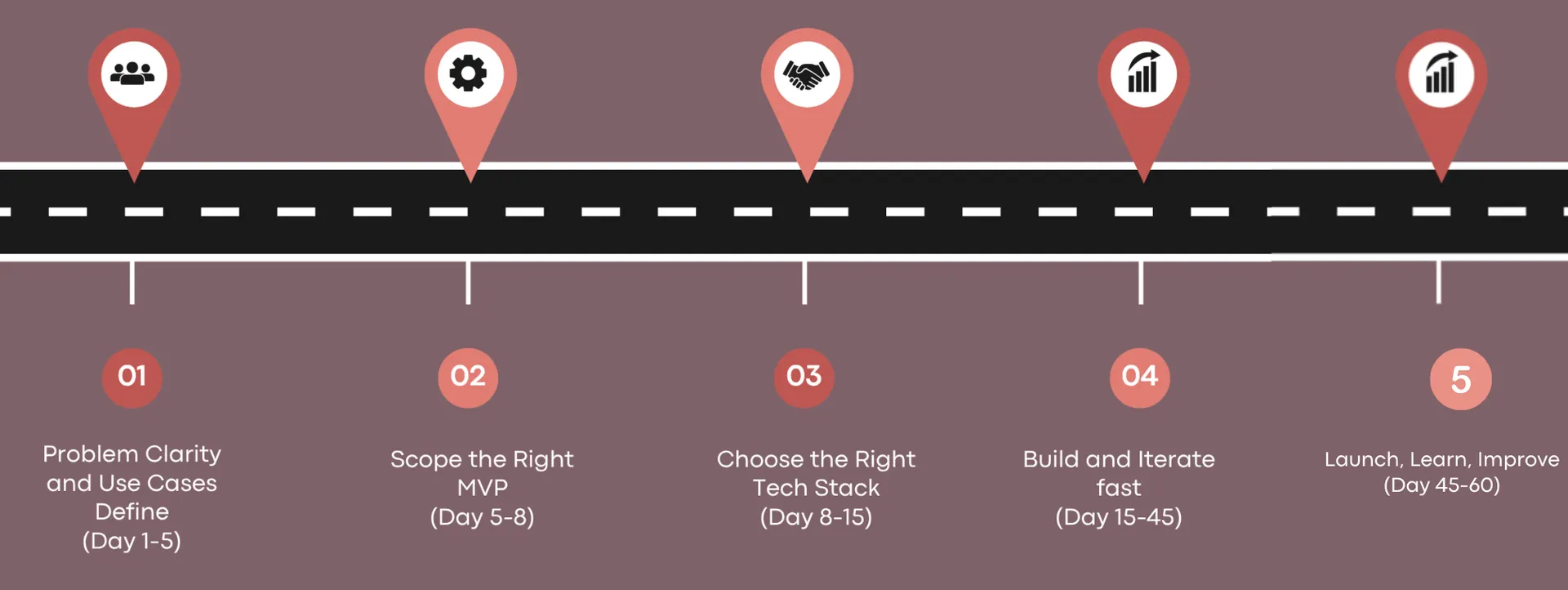
Phase 3: Choose the Right AI Stack (Days 10–15)
You don’t need to build models from scratch.
Modern AI app development relies on:
- APIs like OpenAI / Claude / Gemini
- Pre-trained models
- Lightweight backend (Node.js, Python)
- Frontend (React / React Native)
The goal is simple: Focus on experience, not infrastructure.
Phase 4: Build & Iterate Fast (Days 15–45)
This is where your AI MVP becomes real. Break development into weekly sprints:
Week 1–2:
- Core AI integration
- Basic UI
Week 3–4:
- Improve responses/output quality
- Add essential flows
Week 5–6:
- Stability + performance
- Early user testing
Focus on response accuracy, latency, and user experience clarity, not perfection. According to Gartner, the average AI project takes 8 months to go from prototype to production. A sprint-based MVP approach cuts that timeline by more than half. (Source: Gartner, via Informatica)
Phase 5: Launch, Learn, Improve (Days 45–60)
Launch your AI MVP to early adopters, closed user groups, and beta testers. Track what users engage with, where they drop off, and how AI outputs perform, then iterate fast.
MVPs with proper testing before launch have a 60% higher user retention rate. (Source: Startup Genome 2024, via AmericanChase) This is where your MVP becomes a real AI product.
Common Mistakes in AI MVP Development
Avoid these if you want to stay within 30–60 days:
- Trying to build a “complete AI product.”
- Overtraining custom models too early
- Ignoring UX (AI is useless if users don’t understand it)
- Delaying launch for perfection
- Not collecting structured feedback
How MoonDive Approaches AI MVP Development
At MoonDive, we've worked with 40+ early-stage founders and product teams across industries, from healthcare automation to e-commerce personalization, and the pattern is almost always the same: they overbuild before they validate.
We focus on one principle: Clarity over complexity.
Instead of building everything, we help teams:
- Identify the strongest AI use case
- Build a working MVP in weeks, not months
- Integrate scalable AI architecture
- Prepare the product for real-world growth
Because in AI, speed + feedback beats assumptions every time.
Final Thought
If you're thinking about building an AI product, don't start with a scale. Start with a problem. A well-built AI MVP in 30–60 days can validate your idea, attract early users, impress investors, and give you a real competitive edge. And most importantly, it gets you out of the idea stage.
Want to Build Your AI MVP? If you have an idea and want to turn it into a working product quickly, this is the right time to start.
Because the gap between idea and execution is where most products fail.