Django vs Node.js 2025: Backend Choice for Startups
Choosing between Django and Node.js for your startup's backend in 2025? We'll break down performance, scalability, and ecosystem pros and cons.
2 options comparedUpdated
How do they compare, feature by feature?
| Feature | Django | Node.js |
|---|---|---|
| Learning Curve (New Dev) | Moderate (Python + framework specifics) | Moderate (JavaScript + event loop + framework choice) |
| General Performance | Good for CPU-bound, often slower for I/O without async | Excellent for I/O bound, real-time applications |
| Scalability Model |
| Designed for horizontal scaling, microservices friendly |
| Development Speed | Very fast for common web apps (batteries included) |
|
| Ecosystem & Libraries |
|
|
| Concurrency Model | Primarily multi-threaded (WSGI) with growing async (ASGI) |
|
| Typical Use Cases |
|
|
Which one fits your situation?
- Our pickDjango
Go with Django. Its structured approach, ORM, and built-in features will accelerate your development significantly and ensure robustness.
Confidence: High - Our pickNode.js
Node.js is your stronger choice. Its event-driven architecture excels in these scenarios, providing excellent responsiveness and scalability for I/O-bound tasks.
Confidence: High - Our pickNode.js
Node.js will likely lead to higher developer velocity and easier knowledge transfer within your team due to the consistent language.
Confidence: Medium - Our pickNode.js
Node.js is very well-suited for microservices due to its modularity and efficiency in handling network I/O between services.
Confidence: Medium - Our pickDjango
Consider Python (Django, or a separate Python service) for these specific tasks. Node.js can struggle with CPU-bound work, blocking its single thread.
Confidence: High - Our pickDjango
Django's comprehensive feature set means less time configuring and more time building, often resulting in a faster path to a feature-rich MVP.
Confidence: High
What do you get, and what do you give up?
Where it shines
- Provides a 'batteries-included' experience, accelerating development for common web application patterns due to its ORM, admin panel, and robust security features.
- Benefits from Python's extensive ecosystem, especially strong for data science, machine learning, and complex business logic integrations.
- Enforces good architectural patterns through its 'opinionated' framework design, which can reduce technical debt and improve maintainability over time.
- Excellent choice for applications requiring strong data integrity and complex relational database schemas due to its powerful ORM and migrations.
- Mature and stable framework with a large, active, and helpful community, ensuring long-term support and abundant learning resources.
What to weigh
- Can be less performant than Node.js for highly I/O-bound or real-time applications, especially with traditional WSGI servers, though ASGI improves this.
- More monolithic structure might feel restrictive for pure microservices architectures from the ground up, requiring more effort to decouple.
- Learning curve involves not just Python but also Django's specific conventions, ORM, and template language, which can be a lot for newcomers.
- Python's Global Interpreter Lock (GIL) can be a limitation for true CPU-bound parallelism within a single process, requiring multiprocessing for full utilization.
- Deployment and scaling can sometimes feel heavier than a lightweight Node.js service, needing more configuration for optimal performance.
Which should you choose, and why?
Overview
Alright, so you're thinking about picking a backend for a new startup, huh? It's 2025, and honestly, the choice between Django and Node.js still comes up all the time. It's a classic battle, really, and it's not always as straightforward as some people make it out to be.
I mean, you've got your Python enthusiasts pushing Django and your JavaScript folks swearing by Node.js. Both are fantastic for different reasons, but for a startup, where resources are tight and every decision feels huge, you've really got to weigh your options carefully. We don't want to paint ourselves into a corner, do we?
From my experience, it's not just about raw performance numbers. It's about team skills, how fast you need to iterate, what kind of problems you're trying to solve, and honestly, what keeps you from having a panic attack at 3 AM when something breaks. Let's dig in a bit, I'll tell you what I've seen work and what hasn't.
In depth
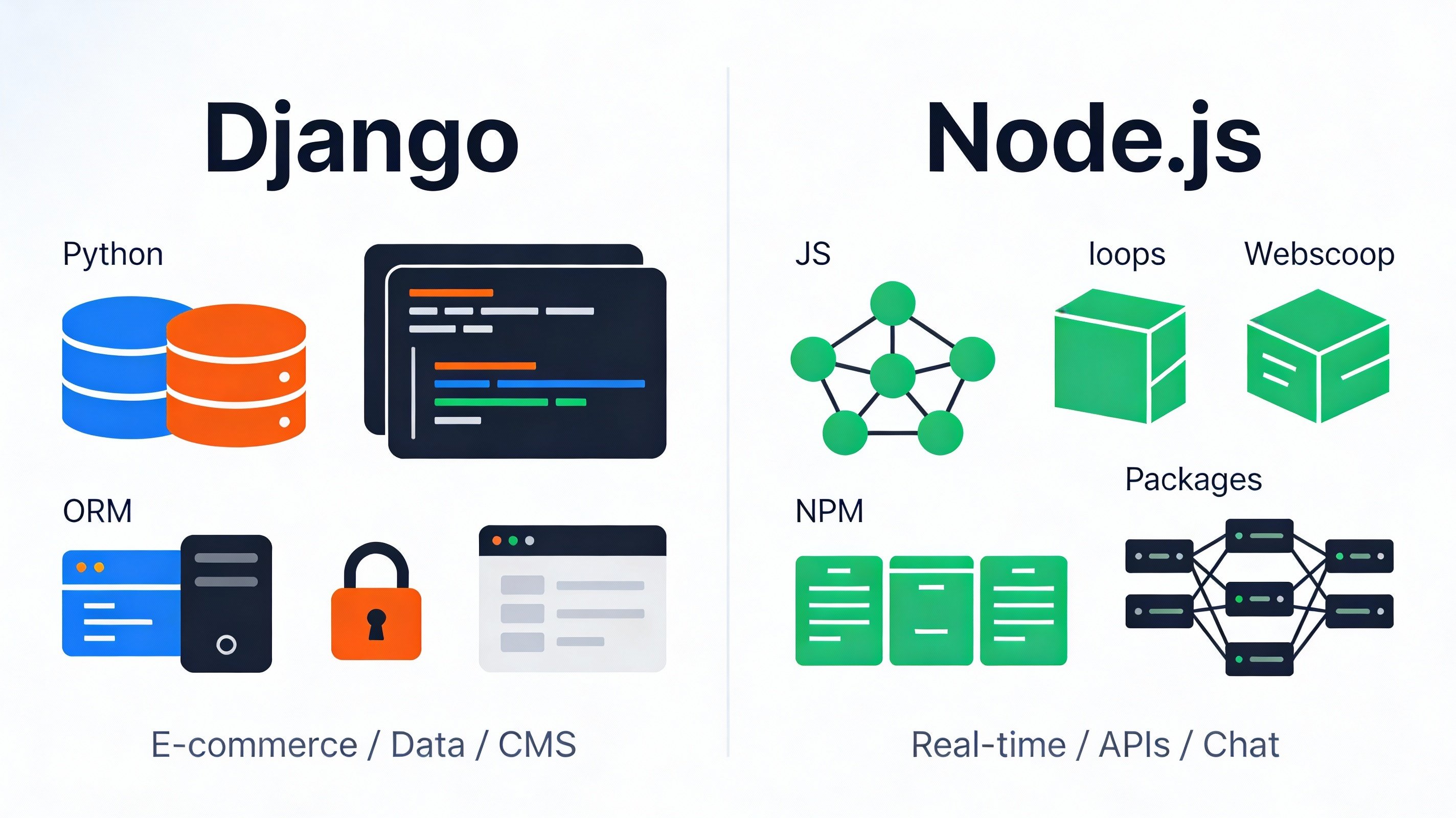
When you're looking at Django, you're looking at Python, right? That's a language many folks already know, it's very readable. Django, especially with Python 3.12 these days, offers a super structured, 'batteries-included' approach. You get an ORM, an admin panel, security features—it's all there, baked in. This means you're not spending a ton of time hunting for packages to do basic web stuff; it's just available. I remember our CTO at 'Cloudburst Analytics' loved how quickly we could spin up secure, data-heavy dashboards with it.
But then you've got Node.js. It's JavaScript on the server, which is a game-changer if your frontend is also JS-based. You're using the same language across the entire stack. That's a huge win for smaller teams, honestly, because developers can jump from frontend to backend with minimal context switching. Node.js is famous for its non-blocking, event-driven architecture, making it incredible for I/O intensive tasks, like real-time communication or handling tons of concurrent connections. My lead developer, Sarah, once built a live sports score app with Node.js that handled millions of users without breaking a sweat, mainly because of how efficiently it manages connections. And yeah, it's often faster for those specific I/O heavy workloads than Django's traditional multi-threaded model, though Django's ASGI adoption is certainly improving that landscape.
Now, regarding the ecosystem, Django has a mature, well-documented Python library landscape. You've got great stuff for data science, machine learning, image processing, you name it. Node.js, on the other hand, lives on NPM, which is just massive. It's got more packages than you could ever imagine for literally everything. But here's the kicker: sometimes that sheer volume in Node.js can lead to 'choice paralysis' or dependency hell. You end up having to make a lot more architectural decisions upfront because it's less opinionated than Django. That's a double-edged sword for a startup, isn't it? More freedom, but also more ways to mess up.
When to use each
So, when do you pick which one? Honestly, if you're building a content-heavy application, a robust e-commerce site, an internal tool with lots of user management, or anything that benefits from a super structured, secure, and 'everything's included' approach, Django is usually your best bet. It's just so good at CRUD operations, and its admin interface can be a game-changer for non-technical users right out of the box. Think about getting an MVP out fast with a lot of built-in features for a project like 'Marketplace Connect', where we needed user profiles, product listings, and a robust search feature in under three months.
Conversely, if your startup's core value proposition relies on real-time features—think chat applications, live dashboards, streaming services, or highly concurrent APIs for a mobile app backend—then Node.js is probably going to serve you better. Its asynchronous nature just shines there. Also, if you're planning a microservices architecture from day one, Node.js fits that model like a glove because it's easier to build smaller, independent services that communicate efficiently. And for teams that are already JavaScript-heavy, perhaps with a React or Vue frontend, keeping the language consistent across the stack just makes hiring and development flow so much smoother. You don't want to hire separate Python and JavaScript teams if you can avoid it, especially on a tight startup budget of, say, $50k for your initial build, do you?
I'd also lean towards Node.js if you foresee needing extremely high performance for I/O operations and don't want to deal with the GIL (Global Interpreter Lock) nuances that Python can sometimes bring, even with async efforts. But what if you're not sure? Well, then you've really got to look at your team's existing skill set. It's almost always easier to pick the technology your current team is strongest in, even if it's not the absolute 'perfect' technical fit on paper. Developer happiness and velocity trump theoretical peak performance in the early days, you know?
In practice
I remember working with a small FinTech startup called 'SecureWallet Co.' about three years ago. Their initial idea was a personal finance tracker. They had a small team, mostly Python folks. We went with Django for the backend. Why? Because they needed robust security, complex database models for transactions, and a rapid way to build out an admin dashboard for their internal analysts. Django's ORM and built-in security features were just perfect. We got a production-ready MVP in about four months on a $70,000 budget, which was pretty amazing given the feature set. They're still using it, actually, just scaled horizontally a bit and it's doing great.
Then there was 'ChatHive,' a social networking startup. They were all about real-time group chats and notifications. We didn't even consider Django much for that, honestly. Node.js with WebSockets was the clear winner there. Our junior dev, Mike, who was mostly a frontend React guy, picked up Node.js with Express and Socket.IO surprisingly fast. We had a working prototype for their chat functionality in literally a two-day hackathon. The unified JavaScript stack meant less context switching and faster iteration for the whole team. They had some performance issues early on because of improper database indexing, not Node.js itself, but once we fixed that, it scaled beautifully to thousands of concurrent users.
And I've seen startups, like 'DataStream Innovations,' try to use Node.js for heavy data processing just because their frontend was React. That was a painful lesson. Node.js is great for moving data around fast, but for heavy number-crunching and CPU-bound tasks, it really struggles compared to Python. We ended up having to offload those specific tasks to Python microservices or even AWS Lambdas. It just added complexity that wasn't necessary. So you see, sometimes you need to use both, or truly understand where each excels.
Expand Your Business
Let’s collaborate and take your business to the next level. Get in touch with our team today!
What else do teams ask about this choice?
Which is better for startup scaling in 2025, Django or Node.js?
Honestly, both can scale. Node.js is inherently designed for horizontal scaling and excels with I/O-heavy, real-time apps. Django, while often perceived as monolithic, scales perfectly well horizontally with good architecture and stateless design. It's more about your specific needs than a blanket 'better' answer.
Is it harder to find developers for Django or Node.js in today's market?
You'll find plenty of developers for both. JavaScript developers are extremely abundant, which means lots of Node.js talent. Python developers are also very common, especially with the rise of AI and data science. The key is finding experienced developers who understand best practices in either ecosystem, not just entry-level folks.
Can Django handle real-time applications as well as Node.js?
Django's traditional stack isn't as naturally suited for real-time as Node.js. However, with ASGI (Asynchronous Server Gateway Interface) and tools like Django Channels, it absolutely can handle real-time features. It just requires a bit more setup and understanding than the immediate simplicity of Node.js with WebSockets.
What about security? Is one inherently more secure than the other?
Neither is inherently more secure. Django has many built-in security features, like CSRF protection and SQL injection prevention, which is a huge benefit. Node.js's security depends heavily on how you implement it and the third-party packages you use. Good development practices and keeping dependencies updated are critical for both.
Which framework is faster to develop an MVP with for a startup?
For a 'standard' web app with a database, authentication, and an admin, Django can be incredibly fast for an MVP because of its 'batteries-included' approach. For a pure API or a real-time app, Node.js with a lightweight framework like Express can also be very fast. It really depends on what your MVP needs to do.
Will I save money on hosting or infrastructure with one over the other?
Not significantly. Both can be deployed efficiently on cloud platforms like AWS, Azure, or GCP. Node.js might use fewer resources for high concurrency if optimized correctly, potentially saving some costs there. But generally, infrastructure costs are more about architectural design and optimization than the specific backend language.
What's the typical learning curve difference for a new developer?
Both have a moderate learning curve. For Django, you're learning Python and the Django framework's conventions. For Node.js, you're mastering JavaScript (including async patterns) and typically a framework like Express. If you already know JavaScript well, Node.js might feel more natural, but if you value structured learning, Django can be very welcoming.
Can I use both Django and Node.js in the same startup project?
Absolutely! This is actually a very common strategy, especially in microservices architectures. You might use Django for a robust admin panel or complex data processing services, and Node.js for real-time APIs or specific high-traffic services. It's about picking the best tool for each specific job, not just one size fits all.
More comparisons.
AWS Lambda vs Azure Functions vs Google Cloud Functions 2025
6 features · 10 scenariosRead the comparisonAI Deployment Platforms Compared: Best Picks for 2025
6 features · 5 scenariosRead the comparisonReact Native vs Flutter vs Native iOS/Android - Complete 2025 Comparison
6 features · 8 scenariosRead the comparison
Still choosing between two good options?
Tell us what you are building. We can walk through the trade-offs with you and help you pick the stack that fits your product.